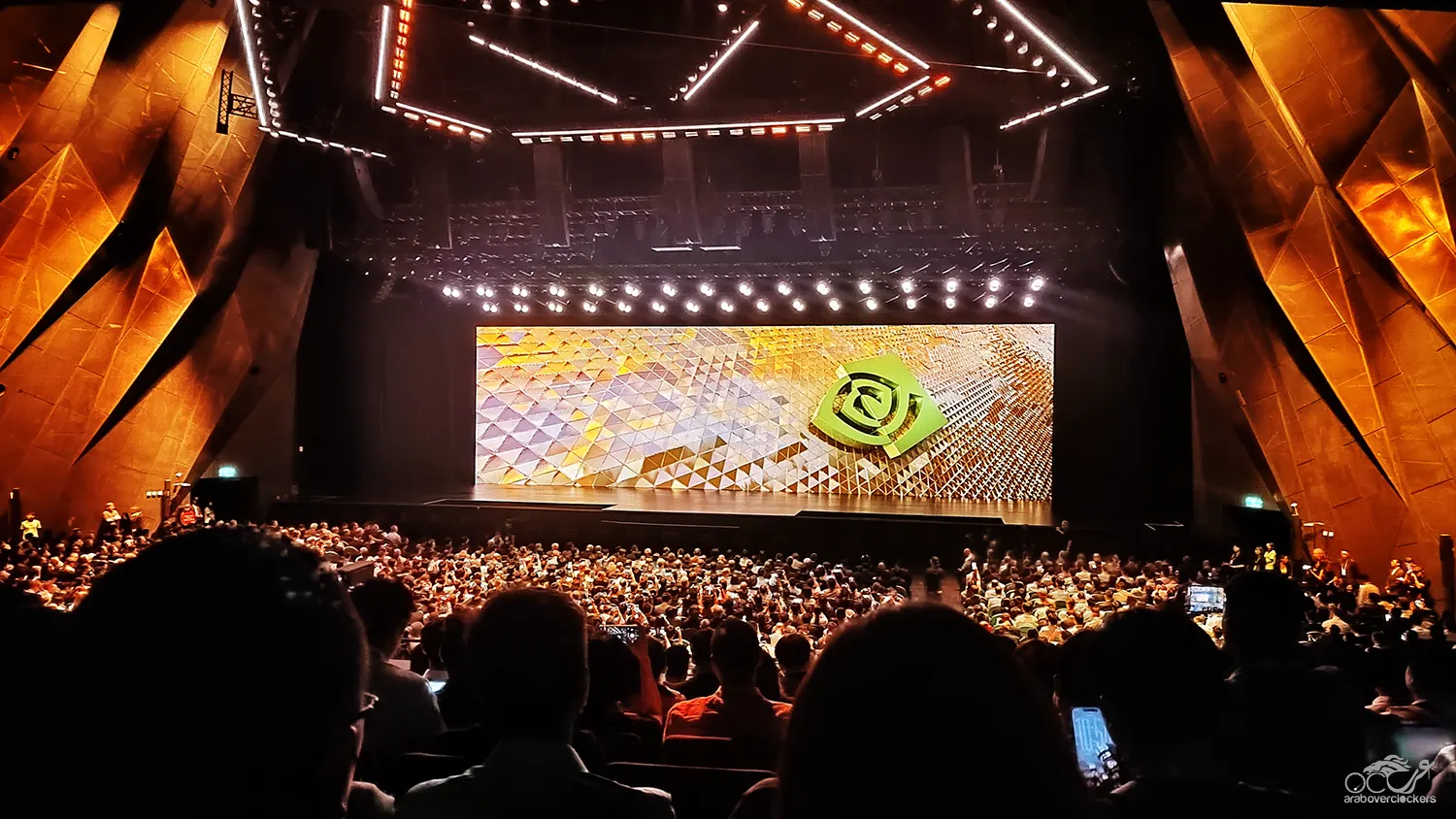
Whenever Jensen Huang takes the stage, the technology industry pays attention. Over the years, NVIDIA’s keynote presentations have become predictable in one sense: the expectation of something faster, bigger, and more powerful. A new processor architecture, a more capable computing platform, another leap in AI performance, or a breakthrough in accelerated computing.
Yet GTC Taipei 2026 felt fundamentally different.
After hours of product announcements, technical demonstrations, roadmap updates, performance metrics, and architectural deep dives, the most important takeaway had very little to do with hardware specifications. It was not about transistor counts, memory bandwidth, network throughput, or even the next generation of AI accelerators.
For the first time in many years, NVIDIA did not appear to be trying to convince the world to buy a new product.
Instead, it was attempting to convince the world to adopt a new way of thinking about computing itself.
At its core, GTC Taipei 2026 was not really about Vera Rubin, despite the platform’s central role in the presentation. Nor was it primarily about CUDA, even though NVIDIA’s software ecosystem occupied a significant portion of the discussion. Even the repeated emphasis on Agentic AI was only one piece of a much larger narrative.
The central message that surfaced repeatedly throughout the keynote was far more profound: artificial intelligence is no longer an application running on top of infrastructure. It is becoming the infrastructure itself.
This explains why NVIDIA chose to begin the conversation from an unusual angle. The company did not open by discussing GPUs, servers, networking equipment, or data centers. Instead, it focused on tokens.
That decision was not accidental.
In NVIDIA’s view, tokens have become the raw material of a new economic system. Previous industrial eras transformed natural resources into products. Oil became fuel. Metals became machinery. Electricity became manufacturing capacity. In the AI era, data becomes knowledge, knowledge becomes inference, and inference becomes action. The mechanism that enables this transformation is the continuous production and processing of tokens at unprecedented scale.
At first glance, this may sound like a technical observation. In reality, it represents a significant economic shift.
When a company the size of NVIDIA begins discussing tokens as units of production, it is no longer talking merely about software. It is talking about industry. Likewise, when data centers are described as AI factories rather than computing facilities, the change is not simply semantic. It reflects a deeper redefinition of the role computing plays within the global economy.
Equally important is where this message was delivered.
The center of gravity for this transformation is not Silicon Valley alone, nor the world’s financial capitals. It is Taiwan.
For decades, Taiwan has been known as the manufacturing backbone of the electronics industry. Today, it is increasingly becoming the industrial foundation of the AI economy. Standing on a stage in Taipei, Jensen Huang was not simply introducing a new generation of technology. He was declaring that the next phase of artificial intelligence has already begun.
Artificial Intelligence Is No Longer an Experiment
Over the last several years, generative AI has dominated the technology landscape.
Millions of people have interacted with ChatGPT and competing systems. Enterprises have rushed to integrate AI assistants into their products and workflows. Investors have poured hundreds of billions of dollars into companies associated with artificial intelligence.
Yet beneath all of the excitement, one fundamental question remained unanswered:
Can AI evolve from an impressive technology into a genuine economic engine?
At GTC Taipei 2026, NVIDIA appeared convinced that the answer is already clear.
When Jensen Huang repeatedly stated that “useful AI has arrived,” he was not referring merely to improvements in model quality or benchmark performance. He was referring to something much more important: artificial intelligence has finally begun delivering measurable economic value.
To support this argument, Huang pointed to data showing dramatic growth in software development activity on GitHub. The significance of these figures was not the numbers themselves, but what they represent. Rather than reducing human output, AI appears to be amplifying it.
Developers are producing more code. Engineers are solving problems faster. Knowledge workers are completing tasks that previously required significantly more time and effort.
This carries major economic implications.
When a single engineer becomes capable of producing three or four times more output than before, that engineer’s value increases rather than decreases. When knowledge workers become dramatically more productive, companies gain stronger incentives to expand their teams because each employee contributes greater economic returns.
This perspective differs sharply from many of today’s popular narratives surrounding AI and employment.
NVIDIA does not appear to view artificial intelligence primarily as a replacement for human labor. Instead, it views AI as a force multiplier for human capability.
That distinction matters because it changes how demand for computing evolves.
As long as AI remained a research project or an experimental tool, demand for computational resources could grow at a manageable pace. Once AI becomes a direct source of revenue and productivity, however, the equation changes entirely.
The moment artificial intelligence starts generating measurable business value, organizations inevitably want more of it.
As demand for AI increases, demand for computing increases.
And once computing becomes the factor that determines an organization’s ability to generate revenue, it stops being viewed as a cost center and begins to be treated as a strategic asset.
This is precisely where NVIDIA’s broader story begins.
From the company’s perspective, computing is no longer merely infrastructure that supports business operations.
It has become the production line itself.
The Age of Digital Agents Has Begun
If generative AI defined the previous phase of the industry, digital agents are poised to define the next one.
Today, systems such as ChatGPT, Gemini, and Claude are typically understood as conversational interfaces capable of generating text, code, images, and answers. While powerful, these systems largely remain within a familiar interaction model. A user asks a question, and the model responds. A user requests a task, and the model performs it.
The digital agent envisioned by NVIDIA is something fundamentally different.
An agent does not merely respond.
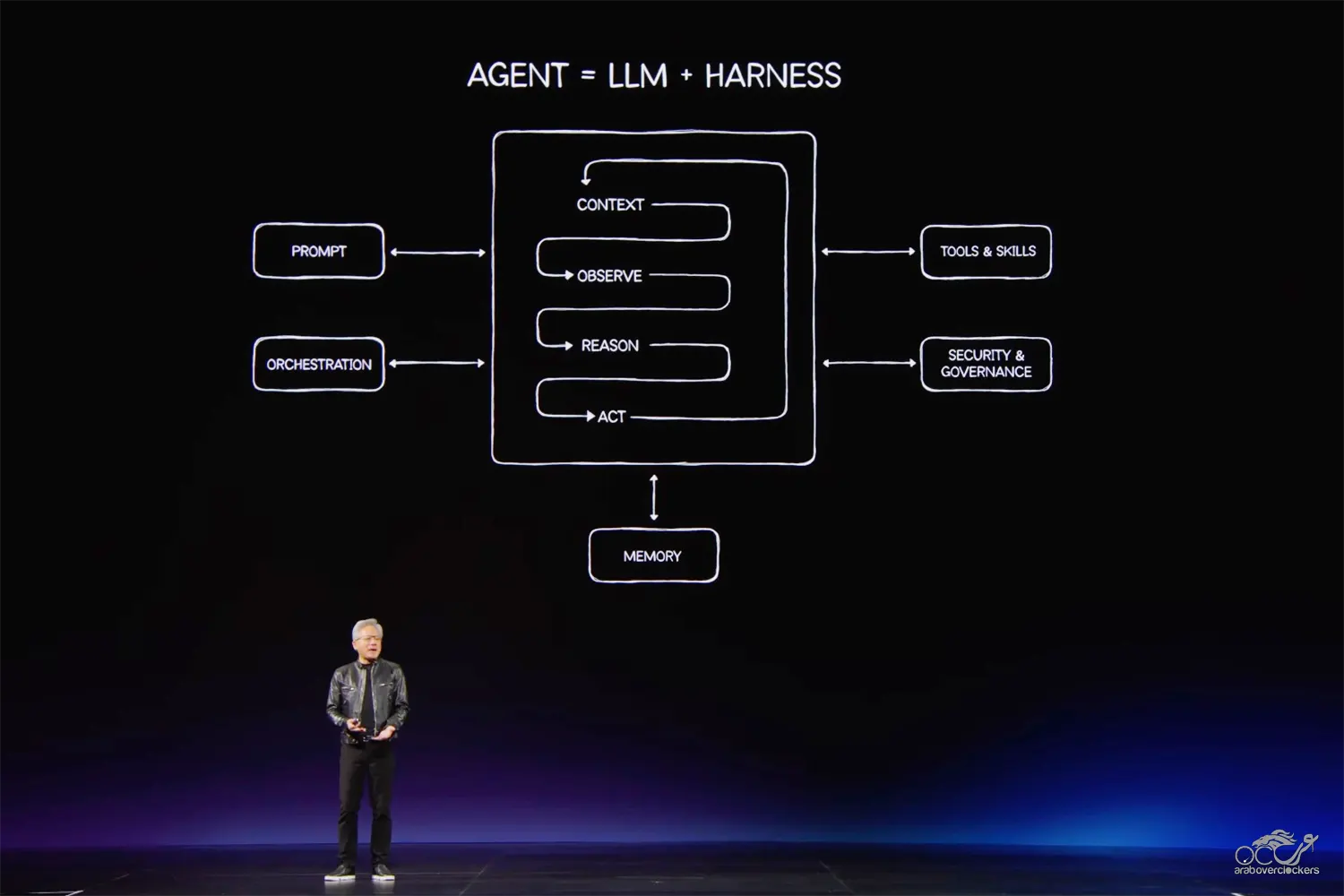
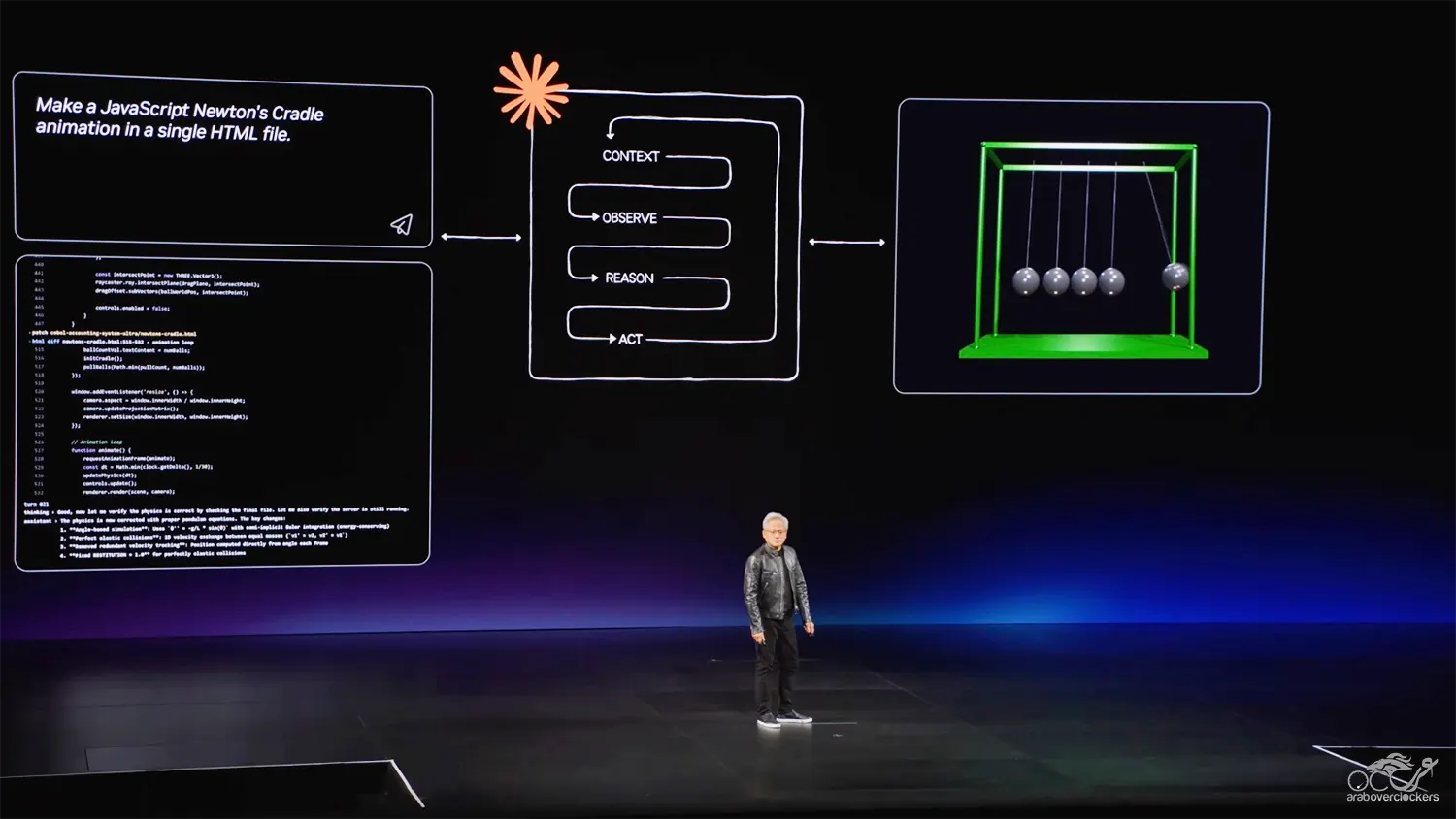
It observes. It understands. It plans. It utilizes tools. It coordinates resources. It makes decisions.
It executes complex sequences of actions in pursuit of an objective.
More importantly, it is not powered solely by a language model. It operates through an integrated system that includes short-term memory, long-term memory, orchestration layers, planning systems, external tools, databases, APIs, and specialized services.
In simple terms, if a language model resembles a brain, an AI agent resembles an employee.
This distinction may appear subtle, but it represents one of the most significant shifts in the history of software.
For decades, software applications were tools operated directly by humans. Increasingly, we are moving toward a future where software becomes a collection of tools operated by AI systems on behalf of humans.
This is why NVIDIA’s focus on Agentic AI extends far beyond a new industry buzzword.
What the company is describing is an entirely new computing paradigm.
A paradigm in which software, infrastructure, networking, storage, memory, and compute resources must all be redesigned around autonomous digital workers rather than direct human interaction.
And once viewed through that lens, many of the announcements made during GTC Taipei 2026 begin to fit together into a coherent strategic vision.
The conference was not about launching isolated technologies.
It was about building the foundations of a world populated by billions of digital agents operating alongside billions of humans.
The Biggest Misunderstanding in the AI Industry
One of the most fascinating sections of Jensen Huang’s keynote had little to do with hardware, performance metrics, or even digital agents themselves. Instead, it focused on how NVIDIA views the future of software.
Over the past two years, a dominant narrative has emerged across both technology circles and financial markets. The argument is straightforward: artificial intelligence will eliminate a large number of jobs, while traditional software companies will face an existential threat as increasingly capable AI systems take over tasks previously performed by humans.
On the surface, the logic appears reasonable.
If an AI system can write software, generate reports, build websites, create marketing campaigns, analyze financial data, and assist with research, then why would organizations need the same number of developers, analysts, or software platforms?
NVIDIA’s answer is surprisingly different.
The company does not believe that digital agents will replace software. It believes they will consume more software than any group of users in history.
This distinction is critical.
The AI agents described throughout GTC Taipei 2026 are not self-contained entities operating in isolation. To perform meaningful work, they require tools. They need databases to access information. They need analytics engines to process data. They need enterprise platforms, APIs, cloud services, orchestration systems, simulation environments, and specialized software frameworks.
As these agents become more capable, their dependence on such tools increases rather than decreases.
This creates a fascinating paradox.
Many observers assume AI will shrink the software market because intelligent systems can perform tasks that previously required dedicated applications. NVIDIA sees the opposite outcome.
The company believes the software market may expand dramatically because the number of software users is about to increase exponentially.
Historically, software was built for people.
In the coming decade, software will increasingly be built for both people and AI agents.
Every new digital agent effectively becomes a new software user.
Every software user requires tools.
And every tool creates demand for additional platforms, infrastructure, services, and integrations.
Viewed from this perspective, AI is not replacing software. It is creating an entirely new category of software consumption.
This helps explain why NVIDIA showed remarkably little concern about the future of the software industry during the conference. If anything, the company appears convinced that the next decade will generate an unprecedented wave of demand for software.
The difference is that applications will need to evolve.
Instead of being designed exclusively around human interaction, future software platforms will increasingly be designed for machine interaction as well. APIs, structured workflows, orchestration layers, memory systems, and autonomous execution capabilities may become as important as traditional user interfaces.
For investors, developers, and software companies, this may be one of the most important signals hidden within NVIDIA’s broader vision.
The company is not preparing for a world with fewer software users.
It is preparing for a world with billions of new ones.
CUDA: The Empire NVIDIA Built Before Anyone Realized Its Importance
It is easy to think of NVIDIA primarily as a hardware company.
For decades, the company’s public identity revolved around graphics processors, gaming GPUs, high-performance computing accelerators, and AI hardware.
Yet this perception only tells part of the story.
The true source of NVIDIA’s power today extends far beyond silicon.
It resides within software.
When CUDA was introduced more than twenty years ago, it was largely viewed as a developer framework that allowed programmers to utilize GPUs for general-purpose computing tasks. At the time, few could have predicted that CUDA would eventually become one of the most significant competitive advantages in the technology industry.
Two decades later, NVIDIA possesses a software ecosystem that spans thousands of specialized libraries and frameworks.
These libraries support fields ranging from scientific simulation and computational physics to genomics, telecommunications, industrial design, robotics, networking, healthcare, financial analysis, and advanced data processing.
This ecosystem did not emerge overnight.
It is the result of years of investment, partnerships with universities and research institutions, collaboration with industrial customers, and continuous refinement across multiple generations of computing platforms.
What became particularly clear during GTC Taipei 2026 is that this software ecosystem is entering a new phase.
Historically, CUDA was built for developers.
Now it is increasingly being positioned for AI agents as well.
This subtle shift may ultimately prove more important than many of the hardware announcements made during the event.
An AI agent does not merely require intelligence. It requires capabilities. Reasoning alone is not enough.
To perform useful work, an agent must interact with the real world through tools. It must analyze data, execute simulations, optimize systems, model outcomes, retrieve information, and manipulate digital environments.
The moment AI agents gain direct access to CUDA-X libraries and NVIDIA’s broader software ecosystem, those libraries become far more valuable.
They are no longer serving only human developers.
They become extensions of autonomous digital workers.
In practical terms, this means that the software NVIDIA spent twenty years building is evolving into a foundational operating layer for the age of AI agents.
This also helps explain why competing with NVIDIA has become increasingly difficult.
The challenge is not simply designing a faster chip.
Hardware can eventually be replicated.
Recreating twenty years of accumulated software expertise, industry relationships, optimized libraries, developer adoption, and specialized workflows is significantly harder.
While much of the industry remains focused on benchmark comparisons and hardware specifications, NVIDIA appears increasingly focused on something else entirely.
It is building an ecosystem.
And history repeatedly demonstrates that ecosystems tend to outlast individual products.
The End of the Traditional Computing Model
Among the many themes discussed throughout GTC Taipei 2026, perhaps none is more consequential than NVIDIA’s belief that artificial intelligence is not merely an extension of traditional computing.
It represents a replacement for many of its foundational assumptions.
For decades, computing followed a relatively stable architecture.
Applications ran on operating systems.
Operating systems ran on hardware.
The underlying technologies evolved continuously, but the basic structure remained familiar.
The rise of AI agents challenges that structure.
Instead of a single application performing a clearly defined function, modern AI systems increasingly resemble distributed networks of models, memory systems, databases, orchestration engines, tools, APIs, and services working together to achieve a goal.
Each component may operate on a different machine.
Each may reside in a different section of a data center.
Each may process different forms of information at different times.
This introduces a level of complexity that traditional computing environments were never designed to handle.
A digital agent requires continuous access to memory.
It must invoke external tools. It may launch specialized sub-models. It needs to maintain context across extended periods.
It often coordinates multiple systems simultaneously.
All of this demands a degree of synchronization between infrastructure components that conventional computing models rarely required.
This is why Jensen Huang repeatedly emphasized that modern computing is becoming distributed, heterogeneous, and deeply interconnected.
There is no longer a single center of computation.
Instead, computation is spread across GPUs, CPUs, networking systems, memory architectures, storage layers, security frameworks, and orchestration engines operating simultaneously.
This is not merely an engineering challenge.
It is the primary reason NVIDIA is redesigning its infrastructure strategy.
Because the future digital worker does not simply require a more powerful GPU.
It requires an entirely different foundation. And that foundation begins with Vera Rubin.
Vera Rubin Is Not a Chip – It Is an Infrastructure Platform
When NVIDIA unveiled Blackwell, the conversation largely revolved around performance. The industry focused on faster training, larger models, greater efficiency, and the enormous computational capabilities required to support the rapidly expanding AI market.
At GTC Taipei 2026, however, it became clear that NVIDIA wants the market to think differently about its next generation of platforms.
In traditional technology launches, the questions are predictable.
How much faster is it than the previous generation? How many cores does it contain? How much memory does it offer?
What improvements have been made to power efficiency?
Those questions still matter, but they no longer tell the full story.
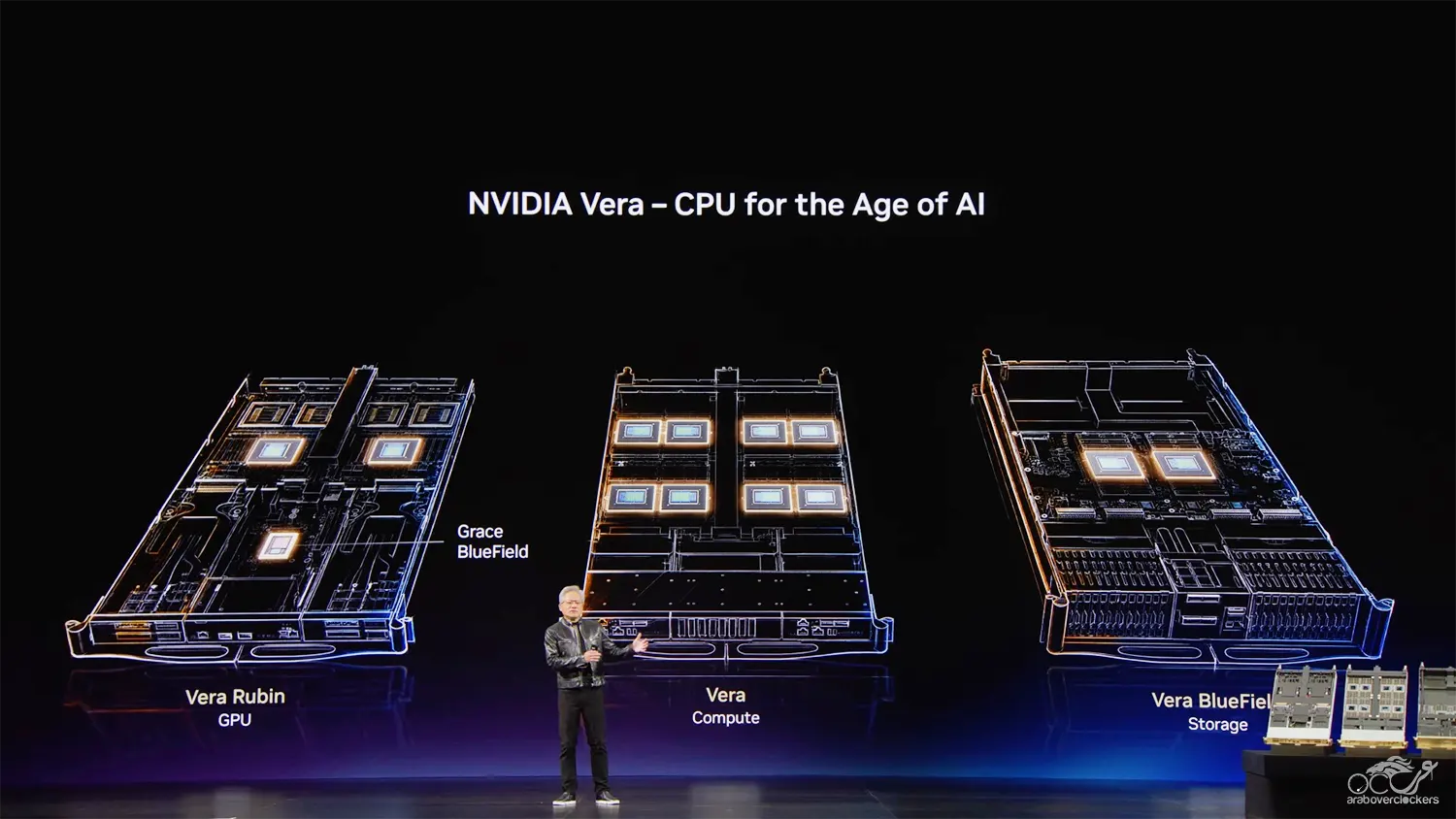
Throughout the keynote, Jensen Huang repeatedly emphasized that Vera Rubin should not be viewed as simply another GPU architecture. In fact, describing it solely as a next-generation graphics processor risks missing the broader strategic significance of what NVIDIA is attempting to build.
The challenge facing modern AI infrastructure is no longer limited to training or serving a large language model.
The industry is moving toward systems that must reason continuously, manage context over long periods, access memory, coordinate tools, interact with external services, launch specialized agents, and process enormous streams of information in real time.
Each of these activities places different demands on the underlying infrastructure.
As a result, the future of AI is not defined by a single processor.
It is defined by how an entire computing system operates as a unified platform.
This is where Vera Rubin becomes important.
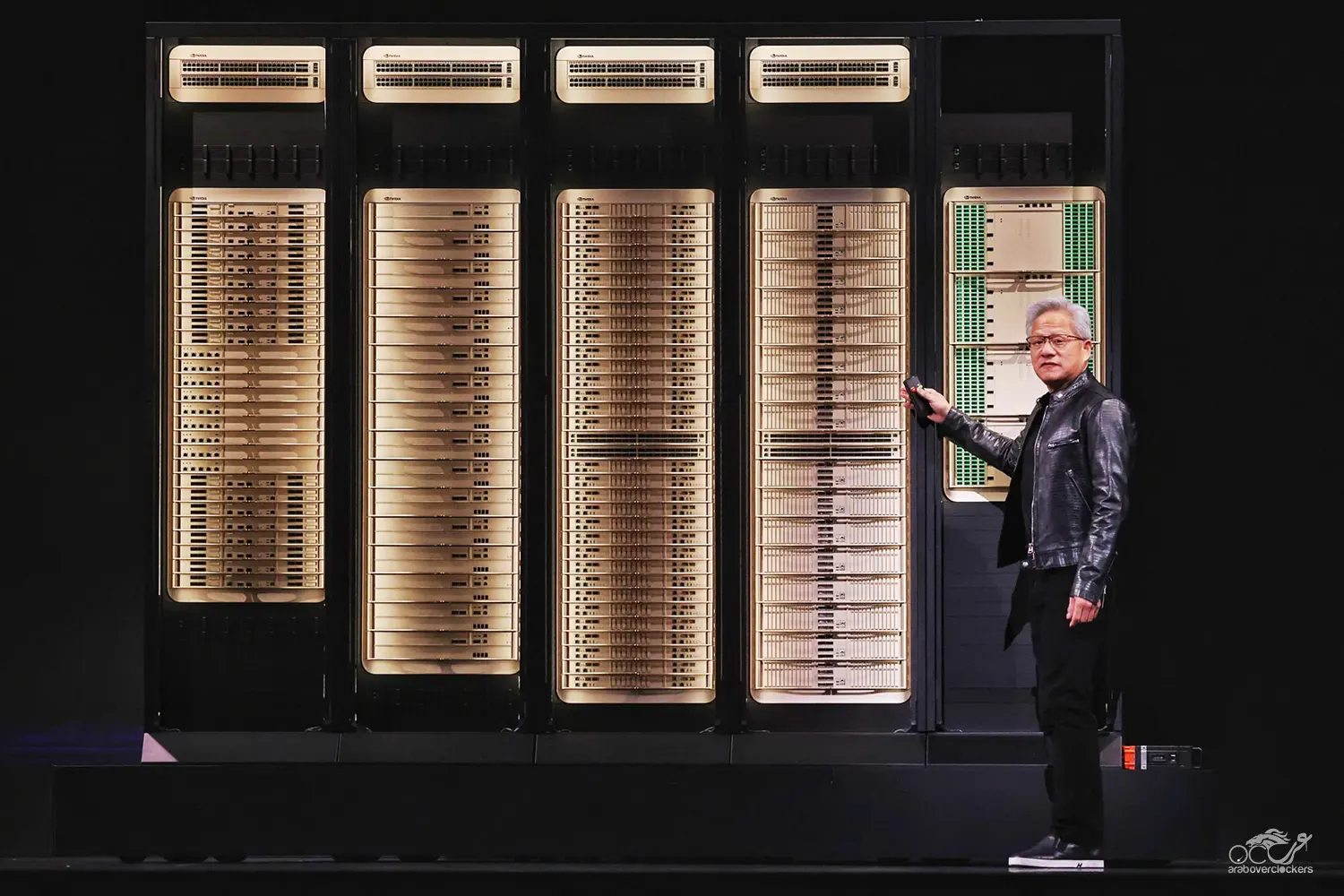
Rather than focusing on one component of the computing stack, NVIDIA is increasingly approaching infrastructure as an integrated system. Processing, networking, storage, memory, security, orchestration, and communication are no longer separate layers that happen to coexist inside a data center. They are becoming parts of a single machine designed specifically for AI workloads.
The significance of this shift cannot be overstated.
For decades, technology companies competed primarily by building better individual components. Faster processors, larger memory pools, improved networking technologies, or more efficient storage solutions were often sufficient to create competitive advantages.
Today, those individual improvements matter less than the ability to integrate them effectively.
The most powerful processor in the world loses much of its value if it cannot communicate efficiently with memory systems, storage layers, networking fabrics, and orchestration engines.
This is why Vera Rubin represents more than a new generation of hardware.
It reflects NVIDIA’s transition from designing chips to designing infrastructure.
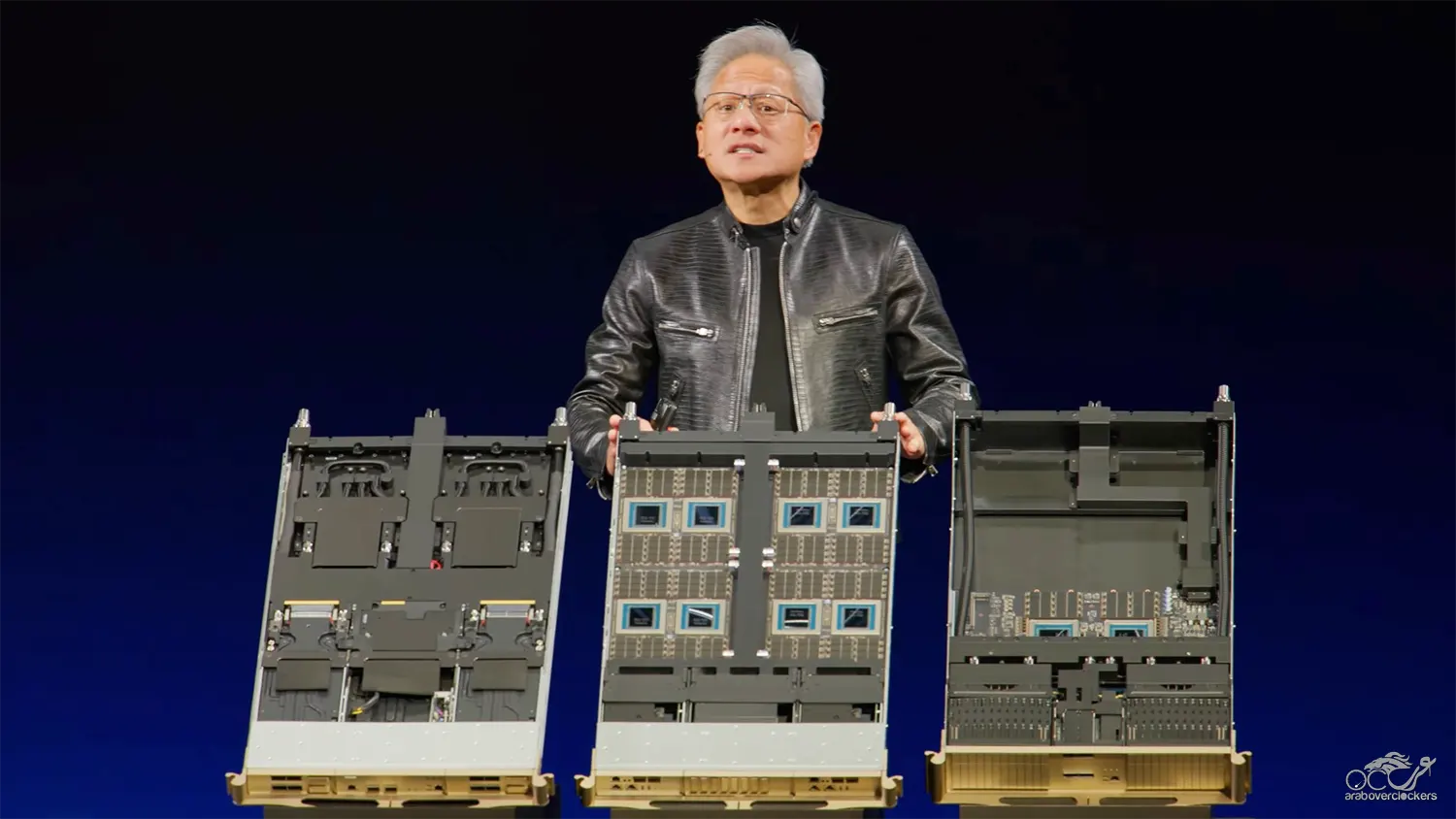
The company is increasingly concerned with optimizing entire computing environments rather than individual components.
Viewed through that lens, Vera Rubin becomes less of a product launch and more of a declaration about the future direction of AI computing.
And that future leads directly to what may have been the most important idea presented throughout the entire conference.
Compute Is Revenue
The Phrase That Defines GTC Taipei 2026
If one sentence captured the essence of GTC Taipei 2026, it was the phrase Jensen Huang repeated multiple times throughout the keynote:
“Compute is Revenue.”
At first glance, the statement appears deceptively simple.
In reality, it reflects one of the most significant economic shifts currently taking place within the technology industry.
For most of modern computing history, computational infrastructure was viewed as a cost center.
Organizations purchased servers. They built data centers.
They paid for electricity, cooling, networking, maintenance, and operational support.
Computing enabled business activity, but it was rarely viewed as a direct source of revenue.
Artificial intelligence changes that equation.
In an AI-driven economy, every successful inference carries value.
Every generated token represents output.
Every AI service delivered to a customer contributes directly to revenue generation.
As a result, computational capacity becomes economically productive in a way that traditional IT infrastructure rarely was.
This changes the fundamental question organizations ask.
Historically, executives focused on how much infrastructure would cost.
Today, many organizations are increasingly focused on how much infrastructure can produce.
That distinction is profound.
When viewed through this lens, performance per watt is no longer merely an engineering metric.
It becomes a financial metric.
The number of tokens that can be generated using a fixed amount of energy directly influences profitability.
The efficiency of an AI system becomes a determinant of economic output.
Every improvement in infrastructure efficiency translates into additional productive capacity.
Every increase in productive capacity creates opportunities for additional revenue.
This helps explain why companies around the world are investing unprecedented sums in AI infrastructure.
The race is not simply about owning more servers.
It is about expanding productive capacity.
In the industrial era, factories generated economic value by transforming raw materials into products.
In the AI era, computing infrastructure generates economic value by transforming data into intelligence.
The comparison is not metaphorical. It is increasingly literal.
This is why NVIDIA repeatedly described modern AI infrastructure using manufacturing terminology throughout the conference.
The company believes that computing has crossed a threshold.
It is no longer simply supporting economic activity.
It has become a form of economic activity.
When Electricity Becomes More Important Than the Processor
If computing has become a source of revenue, then a logical question follows:
What ultimately limits that revenue?
The answer presented throughout GTC Taipei 2026 was remarkably clear.
Energy.
For years, the technology industry concentrated on processor performance.
Discussions revolved around core counts, memory bandwidth, transistor density, and computational throughput.
While those factors remain important, the rise of AI factories is introducing a new constraint.
Power availability.
The world’s largest AI deployments are not merely competing for access to advanced processors.
Increasingly, they are competing for access to electricity.
Many modern AI facilities can theoretically expand their computational capacity much further than they currently do. The limiting factor is often not hardware availability but power availability.
This reality explains why Jensen Huang devoted significant attention to energy systems, cooling technologies, electrical infrastructure, and efficiency optimization.
From NVIDIA’s perspective, these are no longer supporting components.
They are productive assets.
A large-scale AI factory may consume hundreds of megawatts of power. Future facilities may require gigawatts.
At that scale, every watt matters.
Every unit of wasted energy represents lost productive capacity. Every efficiency gain increases output.
Every improvement in power utilization contributes directly to economic performance.
This dynamic is gradually blurring the traditional boundaries between the technology sector and the energy sector.
Historically, computing companies purchased electricity.
Increasingly, access to electricity itself is becoming a strategic competitive advantage.
As AI infrastructure expands worldwide, energy may become one of the most important variables determining which organizations can scale successfully and which cannot.
This reality helps explain why NVIDIA’s vision increasingly extends beyond processors and into broader infrastructure planning.
The company is preparing for a future where the economics of AI are inseparable from the economics of energy.
From Data Centers to AI Factories
Perhaps the clearest illustration of NVIDIA’s changing worldview can be found in the language it now uses to describe computing infrastructure.
For decades, the term “data center” served as the standard description for facilities housing servers, networking equipment, and storage systems.
At GTC Taipei 2026, however, NVIDIA repeatedly favored a different phrase:
AI Factory.
This is more than a branding exercise.
It reflects a fundamentally different interpretation of what these facilities are designed to do.
Traditional data centers performed service-oriented functions. They hosted websites. They supported enterprise applications. They stored information. They ensured operational continuity.
An AI factory serves a different purpose.
Its function is production.
It converts energy, data, and computational resources into an economic output that can be measured, monetized, and scaled.
This distinction lies at the heart of NVIDIA’s vision for the future.
The company believes the world has entered the largest infrastructure expansion cycle in the history of the digital economy.
Governments, hyperscalers, enterprises, and technology providers are no longer merely building data centers.
They are building production facilities for artificial intelligence.
And it is within this context that one of NVIDIA’s most strategically important announcements begins to make sense.
DSX.
DSX: The Most Strategic Announcement NVIDIA Made in Taipei
While most headlines focused on Vera Rubin, a deeper reading of GTC Taipei 2026 points toward a different conclusion.
The most important announcement may not have been a processor architecture at all.
It may have been DSX.
To understand why, it is necessary to understand the problem NVIDIA is attempting to solve.
For most of its history, the company sold chips. Later, it sold complete systems.
Then it evolved toward selling racks, clusters, and increasingly sophisticated integrated platforms.
But the scale of AI infrastructure has now grown beyond the boundaries of traditional product categories.
An organization investing tens of billions of dollars into AI infrastructure is not simply buying hardware. It is attempting to build an industrial asset.
That asset must be designed, simulated, constructed, deployed, operated, optimized, secured, maintained, and continuously improved over many years.
The complexity involved is staggering.
At hyperscale levels, decisions involving cooling architecture, networking topology, power distribution, workload scheduling, resource utilization, and facility layout can have financial consequences measured in billions of dollars.
The traditional technology procurement model was never designed for this environment.
This is where DSX enters the picture.
Rather than presenting another hardware platform, NVIDIA is effectively introducing a framework for designing and operating AI factories as complete economic systems.
The significance of this shift becomes clearer when viewed through an industrial lens.
Manufacturers have long relied on sophisticated planning systems before building physical facilities. Factories are modeled before construction begins. Production lines are simulated before deployment. Logistics chains are optimized before operations start.
NVIDIA appears to believe AI infrastructure is reaching a similar stage of maturity.
Before a single server is installed, organizations increasingly need to understand how an AI factory will perform.
How efficiently will power be utilized? How effectively will cooling systems operate? Where will bottlenecks emerge?
How should workloads be distributed?
How can infrastructure be optimized to maximize economic output?
DSX is NVIDIA’s answer to those questions.
The platform brings together simulation, infrastructure planning, operational intelligence, optimization frameworks, monitoring capabilities, and AI-driven management systems into a unified environment.
In doing so, NVIDIA is attempting to move higher within the value chain.
The company is no longer content with supplying components.
It wants to help design and operate the factories themselves.
This may prove to be one of the most important strategic shifts in NVIDIA’s history.
The company’s ambitions increasingly resemble those of an infrastructure architect rather than a semiconductor vendor.
And if AI factories become the defining industrial assets of the coming decade, the organization that helps design them may ultimately capture more value than the companies supplying individual components inside them.
Taiwan: The Industrial Foundation of the AI Era
There was another message embedded throughout GTC Taipei 2026 that deserves careful attention.
It concerns Taiwan itself.
Much of the global conversation around artificial intelligence focuses on software companies, foundation models, cloud providers, and semiconductor designers. These organizations occupy the headlines and attract the majority of public attention.
Yet the physical reality of AI tells a different story.
Artificial intelligence is becoming one of the most infrastructure-intensive industries ever created.
Models require processors. Processors require manufacturing. Manufacturing requires advanced packaging.
Packaging requires specialized equipment. Servers require assembly.
Infrastructure requires networking.
Every layer depends upon a highly coordinated industrial ecosystem.
And at the center of that ecosystem sits Taiwan.
Throughout the keynote, Jensen Huang repeatedly acknowledged the role played by Taiwan’s technology sector. This was not simply a tribute to his birthplace or an expression of gratitude toward industry partners.
It was recognition of a strategic reality.
Virtually every major AI deployment in the world depends, directly or indirectly, on Taiwanese manufacturing capabilities.
Whether the conversation involves advanced semiconductor fabrication, packaging technologies, server manufacturing, networking equipment, cooling infrastructure, or system integration, Taiwan remains deeply embedded within the supply chain.
This gives the island a uniquely important position in the emerging AI economy.
For decades, Taiwan served as the manufacturing backbone of the electronics industry.
Today, it is increasingly becoming the manufacturing backbone of artificial intelligence itself.
The implications extend far beyond technology. Industrial influence creates economic influence.
Economic influence creates strategic influence.
As AI infrastructure continues expanding globally, the importance of the ecosystems enabling that expansion is likely to increase accordingly.
Viewed from this perspective, GTC Taipei 2026 was not merely a technology conference held in Taiwan.
It was a demonstration of why Taiwan has become one of the most important locations in the future of computing.
What Jensen Huang Was Really Saying
The most revealing messages at major conferences are often the ones that are never stated directly.
They emerge between the announcements. Between the technical specifications.
Between the product launches.
When examining GTC Taipei 2026 through that lens, several underlying themes become apparent.
The first is that the era of standalone AI models is rapidly approaching maturity.
Large language models remain critically important, but NVIDIA’s focus has clearly shifted beyond the models themselves.
The company is now concentrating on what comes next.
Agents. Systems. Infrastructure. Execution. Productivity. Economic output.
The conversation is evolving from intelligence toward action.
A second message concerns the nature of competition.
For years, the industry viewed AI as a race between chips.
Whose processor was faster? Whose architecture was more efficient? Whose hardware could train larger models?
Those questions still matter.
But NVIDIA increasingly appears to believe that future competition will occur at the ecosystem level rather than the component level.
Processors matter. Networks matter. Storage matters. Software matters. Power matters. Security matters.
Operations matter.
The organizations capable of integrating all of these elements into coherent systems may possess far greater advantages than those focused on individual technologies.
A third message is even more significant.
Artificial intelligence is gradually becoming an infrastructure industry.
Many discussions still frame AI as a software revolution.
Certainly, software remains essential.
But once organizations begin discussing hundreds of megawatts of power consumption, multi-billion-dollar facilities, national-scale infrastructure projects, and industrial deployment strategies, the conversation changes.
The economics begin to resemble heavy industry as much as software development.
That transformation may ultimately redefine how governments, investors, and enterprises think about AI.
Perhaps the most important message, however, concerns NVIDIA itself.
The company no longer behaves like a traditional semiconductor vendor.
Its ambitions extend far beyond hardware.
The vision presented throughout GTC Taipei 2026 positions NVIDIA as an infrastructure company.
A platform company. An ecosystem company.
Potentially even an industrial company.
The various announcements, from Agentic AI to Vera Rubin, from CUDA to DSX, all point toward the same destination.
NVIDIA wants to become the foundational layer upon which the AI economy is built.
Conclusion
When Computing Becomes an Industry
Technology conferences often become consumed by specifications.
More performance. More memory. More bandwidth. More efficiency.
These metrics matter.
But occasionally, a conference reveals something larger than a product roadmap.
GTC Taipei 2026 was one of those moments.
Throughout the keynote, Jensen Huang was not simply introducing a new platform or promoting a new generation of hardware.
He was outlining a new economic framework.
Within that framework, computing is no longer merely a supporting technology.
It is a productive asset. Energy becomes a raw material. Tokens become economic output.
AI factories become the modern equivalent of industrial manufacturing facilities.
And infrastructure becomes one of the most valuable strategic resources in the digital economy.
Whether NVIDIA’s vision unfolds exactly as described remains uncertain. History rarely follows a perfectly linear path.
Yet the broader direction appears increasingly difficult to ignore.
Artificial intelligence is evolving beyond software.
It is evolving beyond hardware. It is becoming an industrial system.
Viewed through this lens, GTC Taipei 2026 was not simply a technology conference.
It was a declaration that the next stage of the digital economy will be built around the production, deployment, and operation of intelligence itself.
And NVIDIA is positioning itself not merely as a participant in that transformation, but as one of its principal architects.