Seasonic: The Engineering of Power That Built Its Position in the PSU Market
In the world of PC components, some products deliver results that are immediately visible to the user, such as processors, graphics cards, and storage devices. Others operate quietly in the background, often unnoticed until something goes wrong. The power supply unit, or PSU, clearly belongs to the latter category.
A PSU does not increase frame rates, reduce application loading times, or produce performance gains that can be immediately seen in conventional benchmarks. Yet it is responsible for converting incoming AC power into stable electrical power that every other component inside the system depends on.
For this reason, PSU quality cannot be reduced to the wattage printed on the label or the efficiency certification displayed on the box. Voltage regulation, ripple, transient response, conversion efficiency, component quality, thermal management, protection mechanisms, manufacturing quality, and pre-shipment testing all play an important role in determining the quality of a power supply.
It is from this perspective that Seasonic‘s position in the PSU market becomes easier to understand.
Founded in 1975, the company built its identity around the research, development, design, and production of power-conversion solutions before becoming one of the world’s recognized names in power supplies for PCs, workstations, servers, and communications applications.
However, the company’s longevity alone does not explain its position in the market.
What matters more is that Seasonic has built much of its identity around engineering and platform development rather than simply around the finished products carrying its logo.
From 1975 to Modern Power Supply Engineering
Sea Sonic Electronics was founded in 1975 by engineers, while the company began producing switching power supplies for computers in 1980. It gradually evolved into a company specializing in this field.
According to the company’s documentation, its activities today include the design, research and development, manufacturing, and marketing of power supplies for PCs, workstations, servers, communication systems, and other applications.
This history places Seasonic among a relatively small group of companies with decades of accumulated experience in power-supply engineering. That experience is not limited to developing a particular model or product family, but extends across successive generations of power-conversion technology.
The company’s activities also extend beyond products sold under the Seasonic brand. Its annual reports identify OEM/ODM operations as part of its business, with its experience in developing and designing key components and platforms allowing it to provide solutions for other brands and companies alongside its own products.
This highlights an important aspect of understanding the PSU industry.
The brand name printed on a PSU does not necessarily tell the user who designed its platform or manufactured it. The PSU industry relies heavily on specialized companies capable of developing and manufacturing power-supply platforms. As a result, independent expertise in design, R&D, and manufacturing becomes an important part of building long-term engineering knowledge.
Seasonic states in its official documentation that it develops key components and maintains independent design and development capabilities, in addition to its OEM/ODM business.
At the same time, its manufacturing model should not be interpreted as meaning that every component and every production process takes place within a single company-owned facility. Instead, Seasonic combines its own manufacturing capabilities with a network of processes and partners depending on the product and production requirements.
This is a more accurate description than simply saying that “Seasonic manufactures everything itself.”
Active PFC: An Early Step Toward More Efficient Power Supplies
One of the notable milestones in Seasonic’s history was its development of Active Power Factor Correction, or Active PFC, solutions.
The company states that in 2000, before the mandatory implementation of European CE requirements related to power-factor correction, it introduced cost-effective Active PFC solutions aimed at the personal-computer market. Seasonic identifies this development as one of the milestones that contributed to the evolution of its power-supply engineering expertise.
The importance of Active PFC goes beyond efficiency alone. Power-factor correction improves the way electrical power is drawn from the grid and can reduce certain forms of loss and current distortion. It has since become a fundamental part of modern power-supply design.
More importantly, these developments were not isolated events in Seasonic’s history. They formed part of a longer process of improving power-conversion architectures, thermal management, and component quality.
Seasonic and 80 PLUS: From an Efficiency Certification to a Design Philosophy
Seasonic’s history with 80 PLUS is another important chapter in understanding the company’s approach to efficiency.
In 2004, Sea Sonic entered into a partnership with Ecos Consulting to contribute to the development of the 80 PLUS initiative and its power-supply efficiency standards. In 2005, Seasonic introduced the SS-400HT, which became the first PC power supply to receive 80 PLUS certification and reach the market under the program’s standards at the time.
The company subsequently continued pushing its products toward higher efficiency levels, progressing through Gold, Platinum, and Titanium.
Seasonic explains that higher PSU efficiency means less input power is lost as heat during the conversion process. Efficiency therefore is not merely a marketing figure; it also affects the PSU’s thermal load and the requirements placed on its cooling system.
There is, however, an important distinction to make.
An efficiency certification alone does not mean that a PSU is superior in every other respect.
A power supply can achieve a high efficiency rating while still needing to be evaluated in other areas, including voltage regulation, ripple, transient response, component quality, cooling, protection, and manufacturing quality.
This is why Seasonic’s history with 80 PLUS becomes more meaningful when viewed as part of a broader engineering evolution rather than simply as a collection of efficiency certifications.
PRIME: The Clearest Expression of Seasonic’s Engineering Philosophy
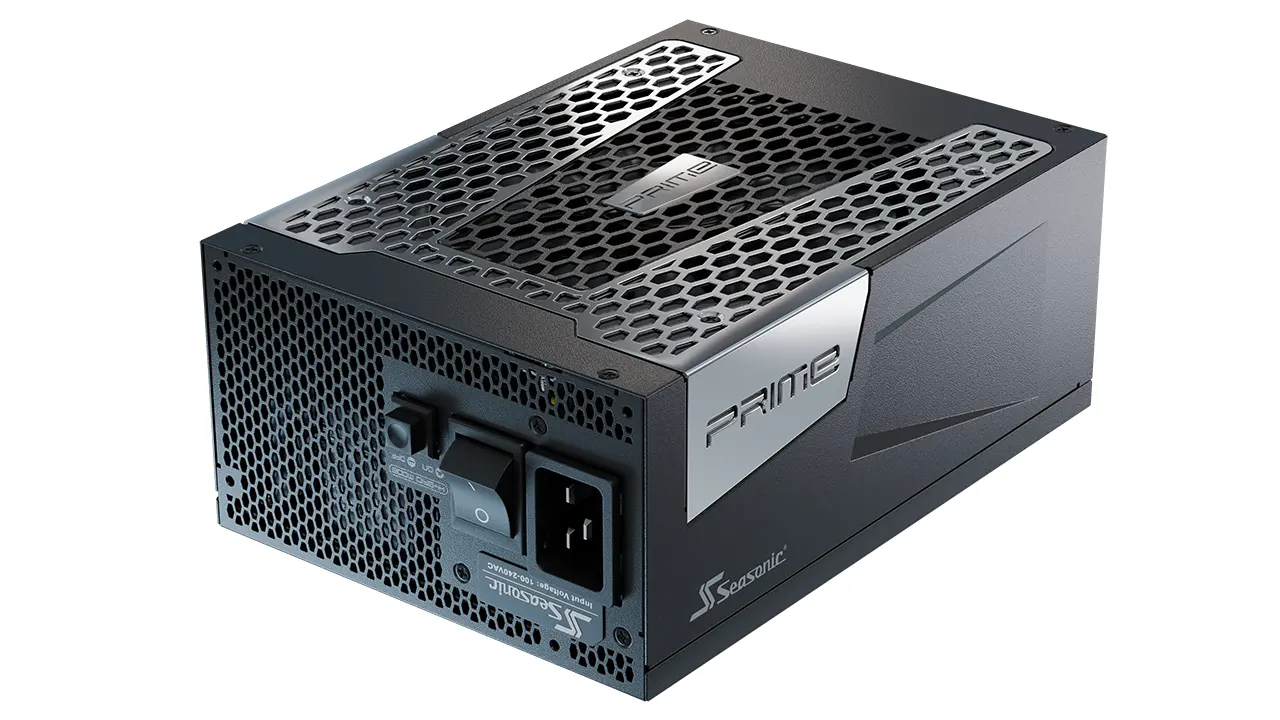
If there is one product family that most clearly represents Seasonic’s approach to the premium PSU segment, it is PRIME.
The PRIME family has evolved into the company’s flagship platform, with an emphasis on high efficiency, component quality, voltage regulation, thermal management, low acoustic output, modular design, and support for high-power systems.
In the current PRIME generation, the highest-capacity models reach 2200W, with 80 PLUS Titanium certification, a fully modular design, and a warranty of up to 12 years. The series also incorporates Premium Hybrid Fan Control and a 135mm fan using a Fluid Dynamic Bearing.
However, the real value of PRIME cannot be reduced to the “2200W” figure alone.
A modern PSU does not operate under a constant load. CPU and GPU power consumption continuously changes, and sharp load transitions can occur over very short periods.
The ability of a PSU to respond to these changes while maintaining stable output voltage therefore becomes a fundamental part of its design.
This is where engineering details that cannot be seen from outside the unit become important.
Micro Tolerance Load Regulation: The Electrical Precision Behind the Number
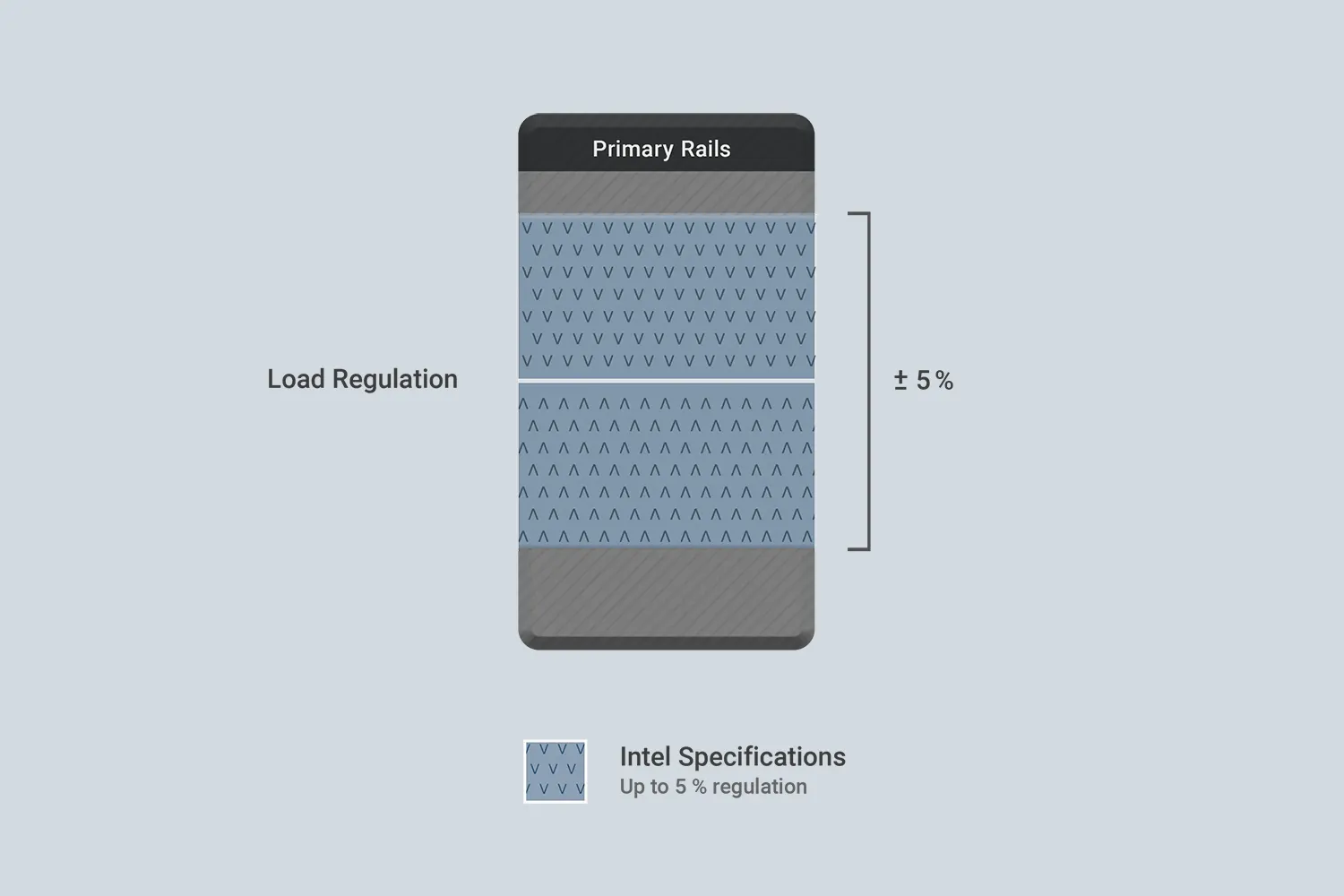
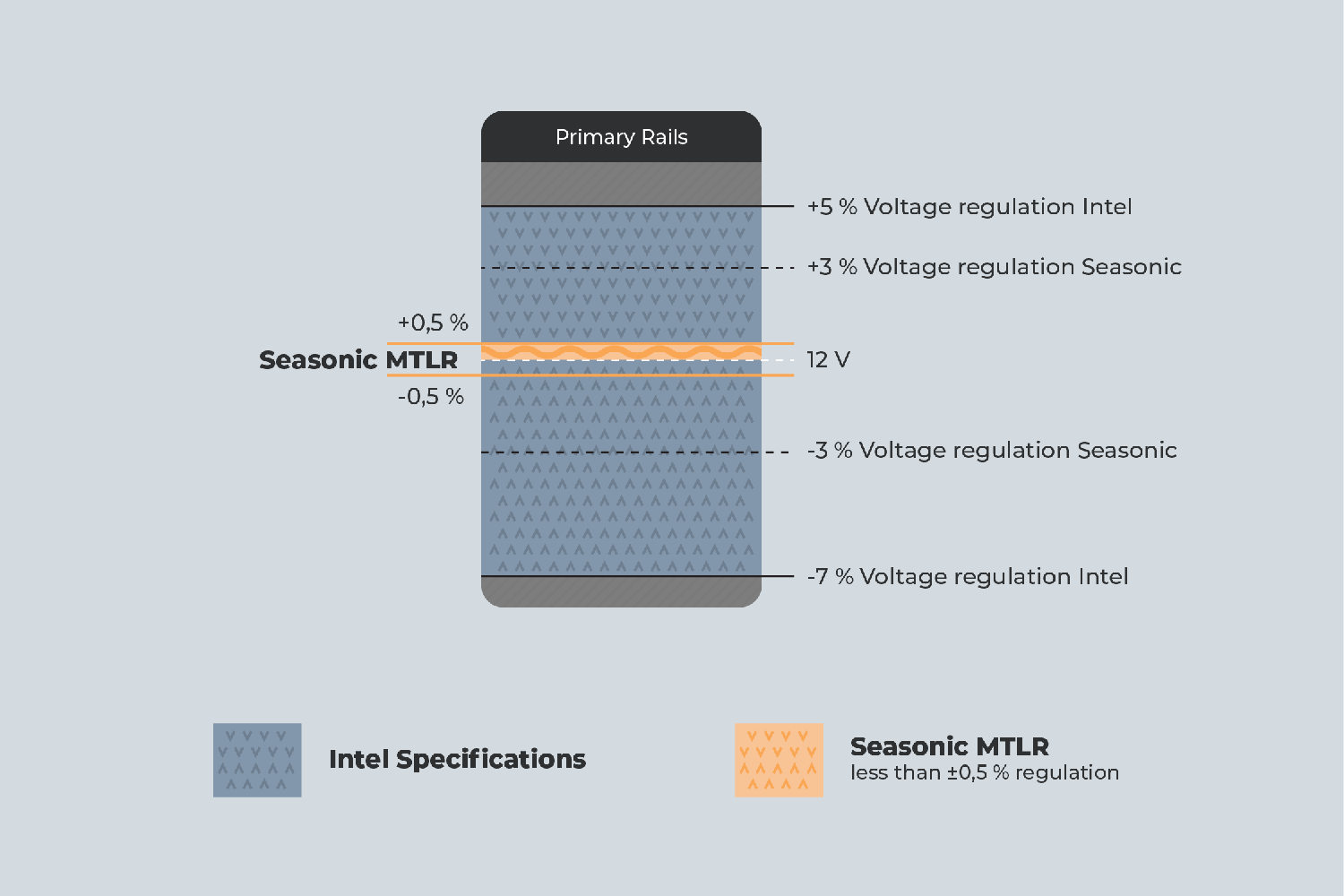
Seasonic’s PRIME platform incorporates Micro Tolerance Load Regulation, with the company stating that the design maintains voltage regulation within a range of less than 0.5%.
This figure does not mean that the PSU is “more powerful” in the traditional sense. Instead, it reflects the precision with which the output voltage is controlled as the load changes.
In a modern system equipped with high-performance CPUs and GPUs, load conditions are constantly changing. The tighter the PSU can keep its output voltage within its specified range, the more consistent the electrical power delivered to the system’s components becomes.
This is one of the reasons professional PSU testing goes far beyond measuring maximum output power. Voltage regulation, ripple, transient response, and other electrical characteristics are all important measurements when evaluating a power supply.
Cable-Free Connection: Rethinking Internal Connection Points
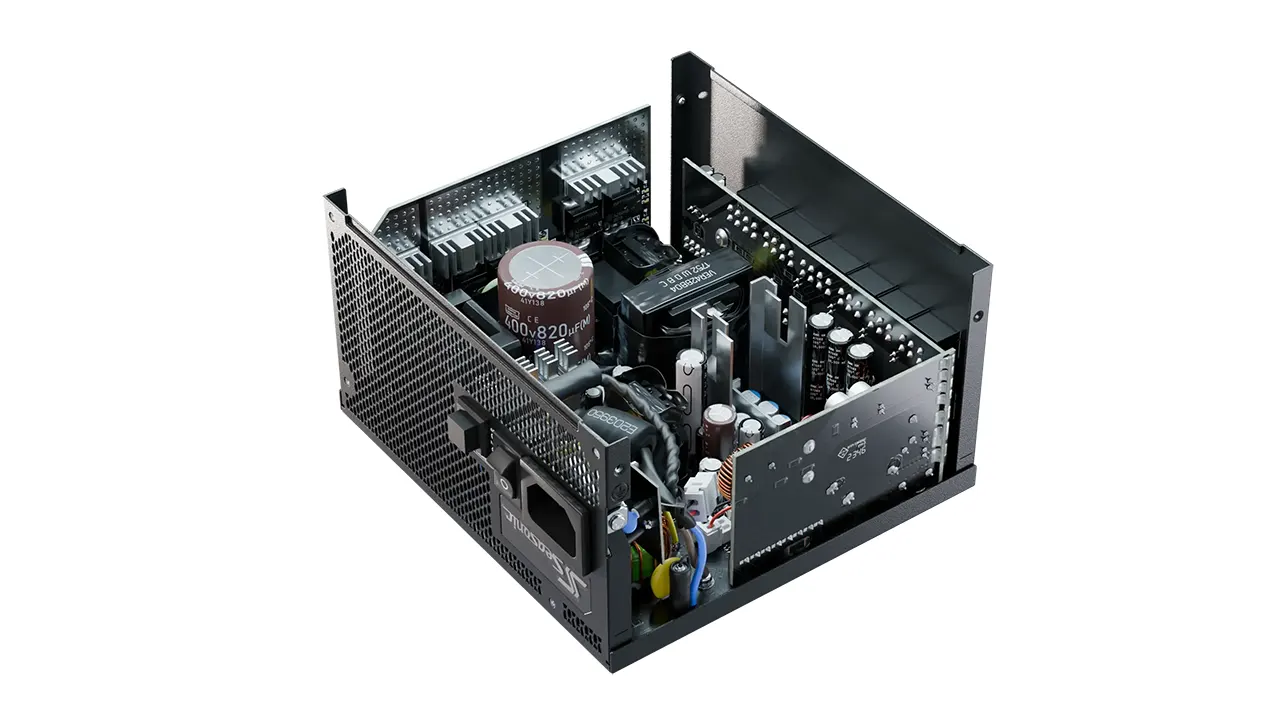
One of the notable technologies used in PRIME is the Cable-Free Connection design.
Instead of using cables at a particular connection point between the PCB and the rear board, Seasonic uses a copper plate to connect the two directly. According to the company, this approach reduces the possibility of production errors associated with manually inserted cables while also helping improve output power quality.
It may appear to be a relatively small design detail, but it reflects a different way of approaching PSU engineering.
In electronics, every additional connection point can introduce resistance, tolerance, or potential assembly errors. Redesigning the internal architecture to reduce these connection points can therefore be more meaningful than adding another feature that is prominently displayed on the product box.
This is the nature of many innovations in power supplies: some of the most important improvements happen inside the enclosure and remain invisible to the end user.
Components: The Part That Specifications Alone Cannot Capture
In the premium segment, having a well-designed electrical platform is not enough. Component selection itself becomes part of the product philosophy.
PRIME uses high-quality Japanese capacitors rated for operation at 105°C, alongside other components designed to withstand the operating conditions expected from this product class. Seasonic also emphasizes the use of high-quality components as part of its approach to long-term reliability.
The thermal rating of capacitors matters because temperature is one of the key factors affecting the operational lifespan of electronic components.
For this reason, improving a PSU does not simply mean selecting a better capacitor in isolation. Higher efficiency reduces thermal losses, an effective cooling system lowers operating temperatures, and appropriately rated components are better suited to withstand demanding operating conditions.
The relationship between components, efficiency, and thermal management is therefore one of the fundamental principles behind long-life PSU design.
OptiSink and OptiGuard: Engineering Within a Limited Space
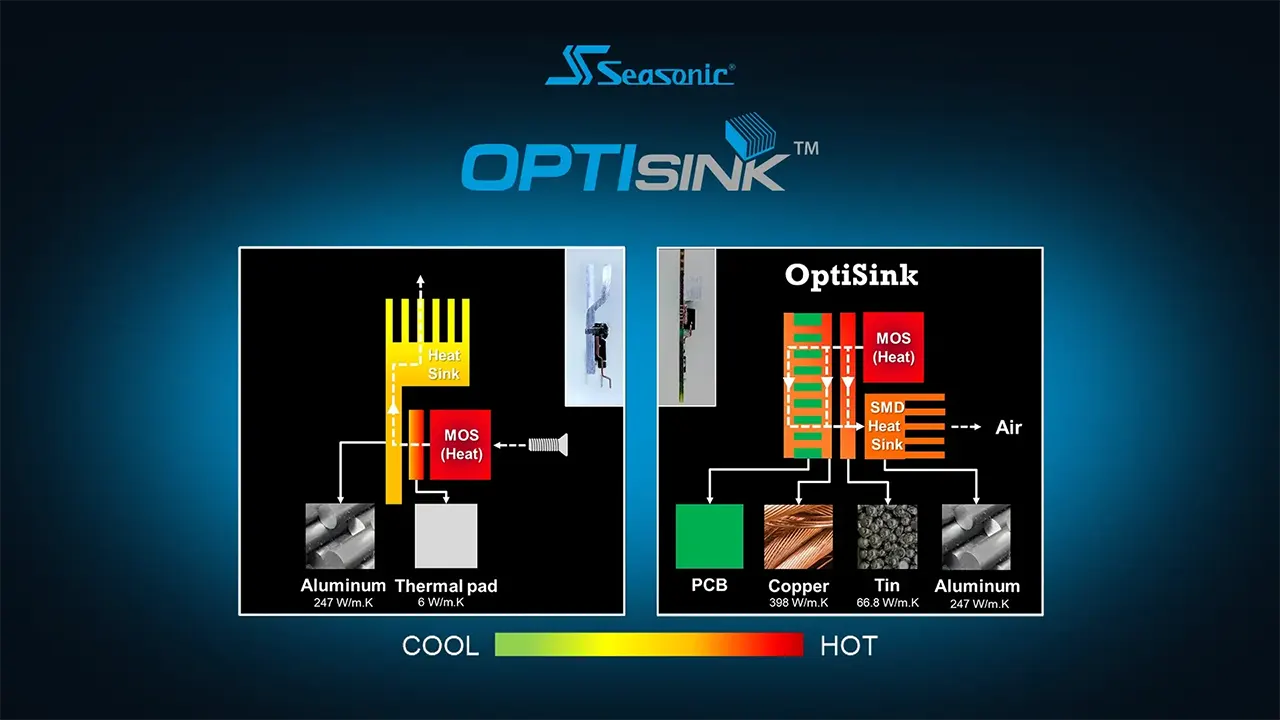
Seasonic has also developed dedicated engineering technologies such as OptiSink and OptiGuard as part of its efforts to improve PSU performance and reliability within the physical constraints of the power-supply enclosure.
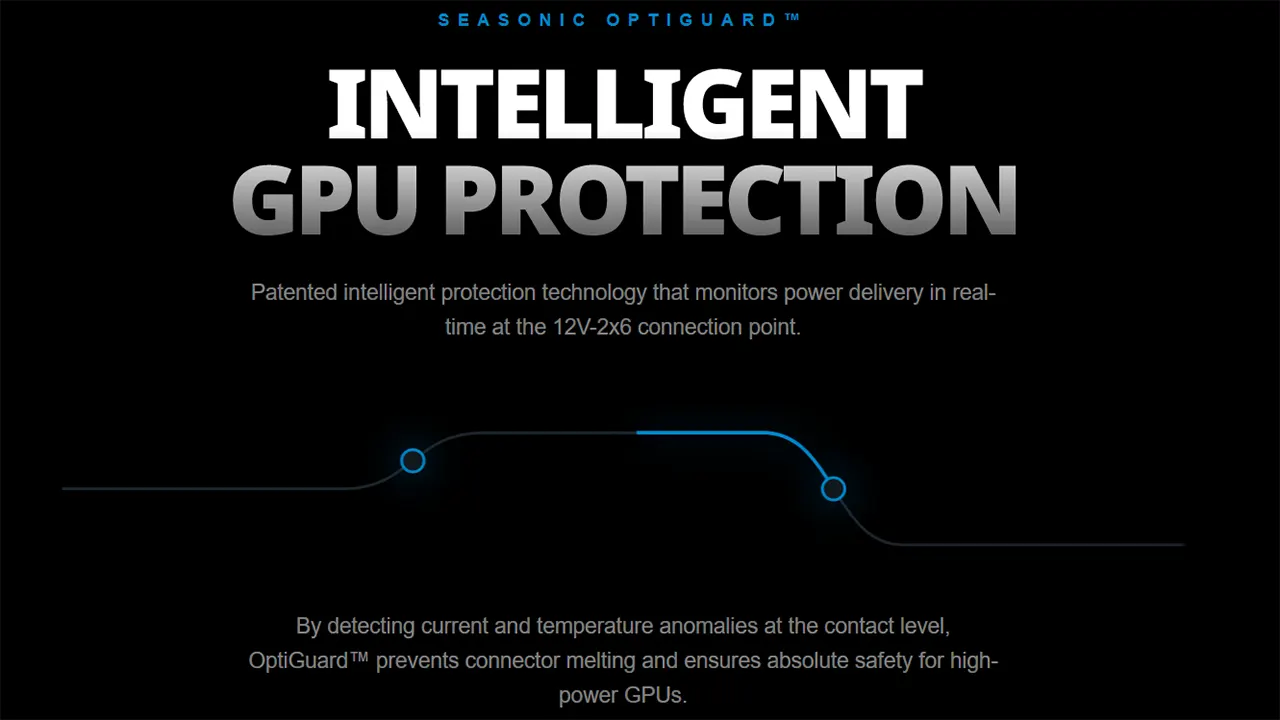
The company places these technologies among the engineering solutions it has developed to improve PSU performance alongside technologies such as Hybrid Fan Control.
The more important point, however, is not the technology name itself but the engineering principle behind it.
A PSU contains a large number of components operating under different electrical and thermal conditions within a limited physical space. Component placement, thermal paths, protection mechanisms, and airflow therefore have to be considered as part of a single system.
This illustrates why electrical design and thermal design cannot be separated in a modern PSU.
Cooling: Balancing Temperature and Acoustics
Higher PSU output generally means that more energy must be converted, increasing the importance of thermal management.
Running a fan at maximum speed continuously, however, is not an ideal solution.
This is why Seasonic uses its Premium Hybrid Fan Control system in PRIME, together with a 135mm Fluid Dynamic Bearing fan. The system is designed to adjust fan operation according to load and thermal conditions rather than simply running the fan at a fixed speed.
The objective is to balance three factors:
temperature, reliability, and acoustics.
At lower loads, fan activity can be reduced, while greater airflow becomes necessary as thermal load increases.
This is particularly relevant for workstations and production systems that operate for extended periods, where continuous acoustic output becomes a practical consideration rather than a secondary detail.
Electrical Protection as Part of the Reliability Philosophy
A PSU is not only responsible for delivering power. It must also be able to respond appropriately to abnormal operating conditions.
PRIME therefore incorporates a range of protection mechanisms, including:
OPP – Over Power Protection.
OVP – Over Voltage Protection.
UVP – Under Voltage Protection.
OCP – Over Current Protection.
OTP – Over Temperature Protection.
SCP – Short Circuit Protection.
Seasonic lists these protection mechanisms among the official specifications of PRIME.
These protections do not make a PSU immune to every possible electrical fault, but they represent an essential layer of the overall reliability architecture, particularly when the PSU is powering an expensive high-performance system.
ATX 3.1: Preparing for the Power Characteristics of Modern Hardware
Power requirements have changed significantly with the arrival of new generations of graphics cards.
It is no longer sufficient for a PSU simply to provide high continuous output power. The platform must also be prepared to handle rapid changes in power consumption.
This is why standards such as ATX 3.1 and the 12V-2×6 connector have become important parts of modern PSU design.
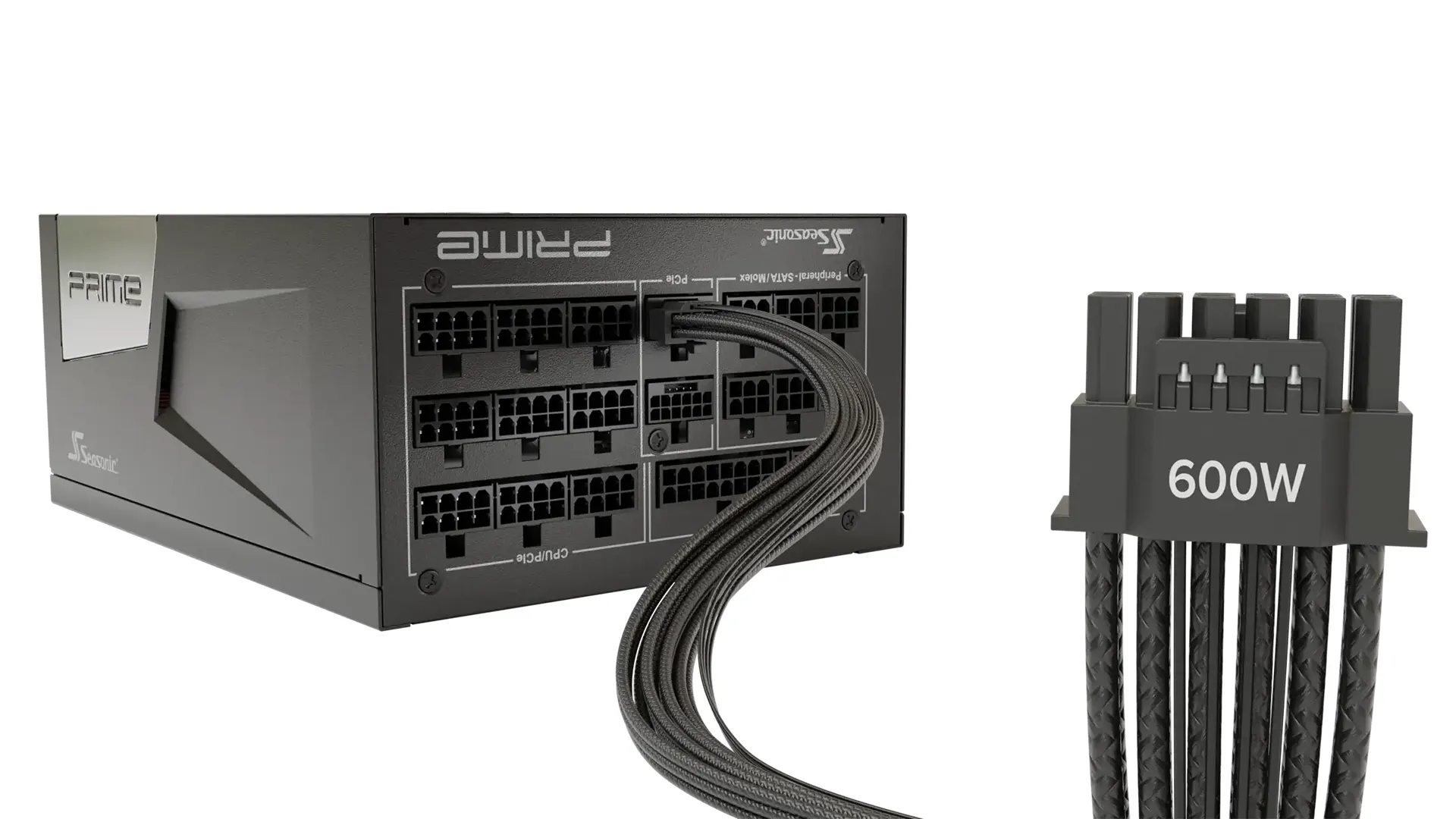
Seasonic offers modern versions of PRIME, VERTEX, FOCUS, and CORE supporting current standards, while the company’s current product information identifies the PRIME ATX 3.1 as a PRIME platform incorporating the requirements of ATX 3.1.
This evolution is particularly important for systems equipped with high-power graphics cards because PSU design must account for the behavior of the load rather than simply the wattage printed on the label.
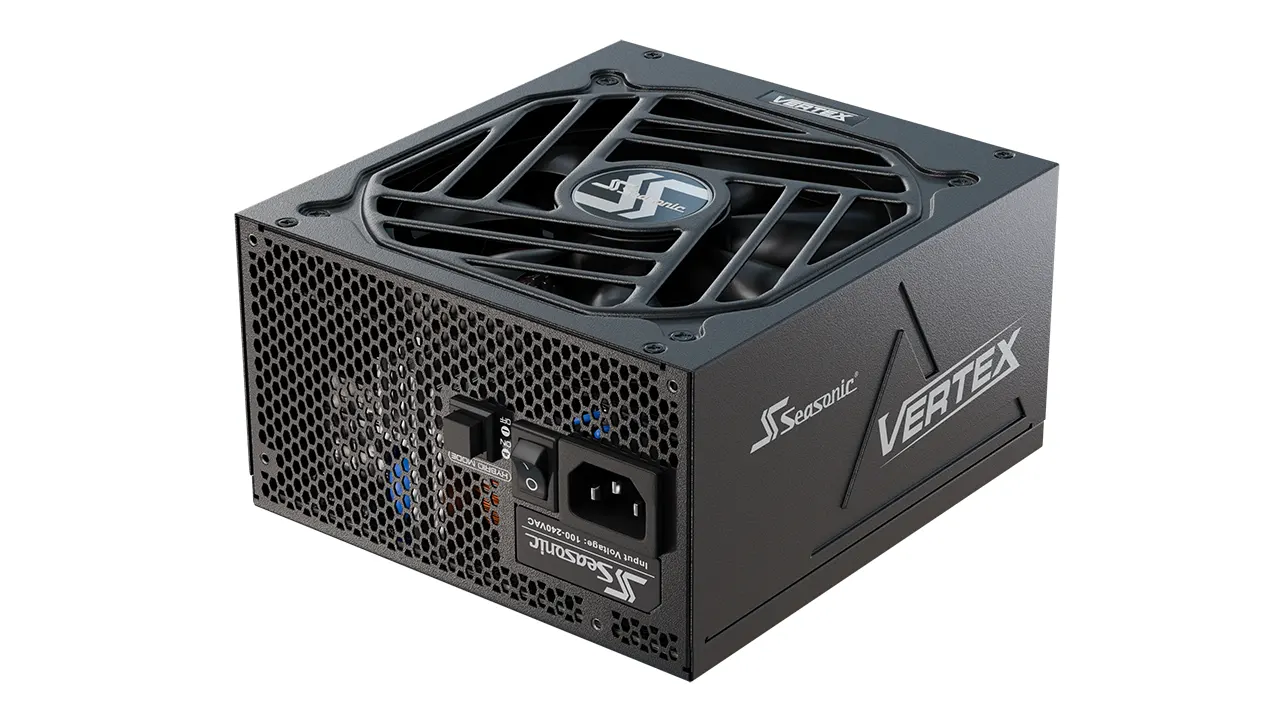
Reliability Does Not Begin With the Warranty
Seasonic offers long warranty periods across several of its product families.
According to the company’s current information, warranty coverage extends to 12 years for PRIME and VERTEX, 10 years for FOCUS, and 5-7 years for CORE, depending on the model.
However, a long warranty alone is not proof of PSU quality.
What matters is what stands behind it: circuit design, component selection, thermal management, protection mechanisms, quality control, and testing.
A long warranty becomes more meaningful when it comes from a company with extensive experience in power-supply engineering and manufacturing and a product philosophy centered around reliability.
Seasonic also states that its design and manufacturing operations are governed by quality processes and ISO standards, linking high-quality design and advanced manufacturing with extended product life.
One Seasonic: Building a Clear Platform Portfolio
Seasonic has not relied on PRIME alone to establish its position in the market.
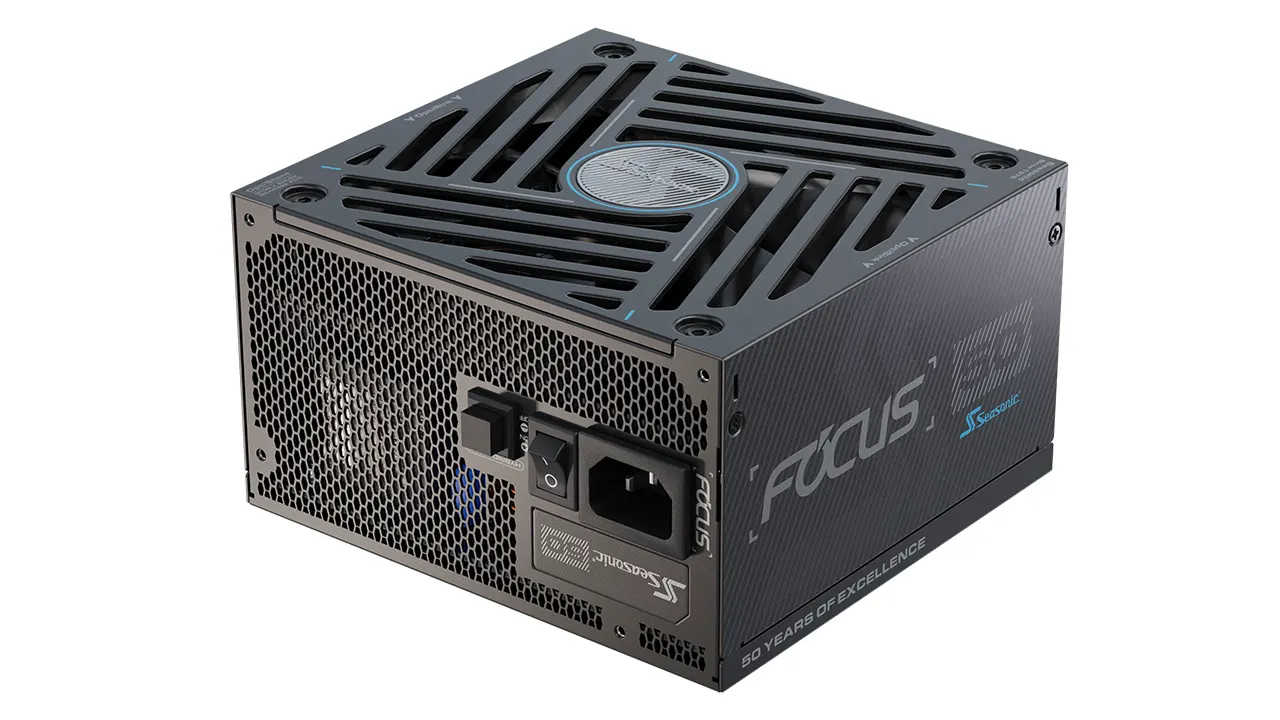
The company reorganized its product portfolio around major families including PRIME, VERTEX, FOCUS, and CORE, covering different performance levels, price segments, and feature sets. This can be seen in the development of its OneSeasonic product strategy, with PRIME positioned as the flagship family alongside FOCUS and CORE, followed by the introduction of VERTEX as a newer generation.
This strategy allows the company to apply its engineering experience across multiple segments rather than concentrating its technologies in a single product.
PRIME occupies the upper end of the portfolio in terms of efficiency, capacity, and features, while VERTEX and FOCUS address different combinations of capacity and features, and CORE targets users who place greater emphasis on value.
The result is a brand identity built around a family of platforms rather than a single flagship product.
The Side of Seasonic Most Users Never See: OEM and ODM
One of the most important aspects of understanding Seasonic as an engineering company is its OEM and ODM business.
The company’s annual report states that Seasonic focuses on the development and production of high-end power supplies and that its brand attracts OEM/ODM business in addition to the products sold under its own name. The company also emphasizes its expertise in developing and designing key components and its independent R&D capabilities.
This matters because the company’s engineering experience is not built exclusively through products consumers see on retail shelves.
Developing power platforms for different requirements and working with other companies and brands provides accumulated experience across different design, manufacturing, and compatibility requirements.
There is, however, an important distinction to maintain.
The existence of an OEM/ODM business does not mean that every PSU sold under another brand is manufactured entirely by Seasonic. Likewise, Seasonic’s independent design and manufacturing capabilities do not mean that every step of its supply chain takes place inside its own facilities.
The more accurate description is that Seasonic combines its own R&D, design, and manufacturing capabilities with OEM/ODM operations and a production network involving partners according to the requirements of specific processes and products.
Why Has Seasonic Positioned Itself as a Premium Brand?
When discussing the term “Premium” in the PSU market, price alone is not enough to define it.
In Seasonic’s case, its premium positioning is the result of multiple accumulated factors: decades of experience, investment in R&D, internally developed platforms, high-quality components in its upper-tier products, high efficiency, precise voltage regulation, protection mechanisms, thermal management, modular designs, support for modern standards, and long warranty periods.
Each of these characteristics can also be found in competing products.
The engineering value emerges from the way these elements work together.
That is why evaluating PRIME purely through a “price per watt” perspective does not provide the complete picture.
The user is not simply buying 1600W.
They are buying a platform designed to deliver that level of output while meeting specific requirements for efficiency, stability, thermal performance, acoustics, and protection.
This is the essence of premium positioning in the PSU segment.
80 PLUS Ruby: A New Milestone in the Pursuit of Efficiency
In August 2026, Seasonic added another chapter to its history with power-supply efficiency standards.
On August 18, 2026, the company announced that the PRIME ENTERPRISE RX-1600 had become the first 115V ATX power supply to receive 80 PLUS Ruby certification, currently the highest efficiency tier within the program. Seasonic describes the product as a high-power PSU designed for desktop computers, workstations, and AI systems.
The significance of this achievement becomes clearer when viewed alongside the company’s history with the program.
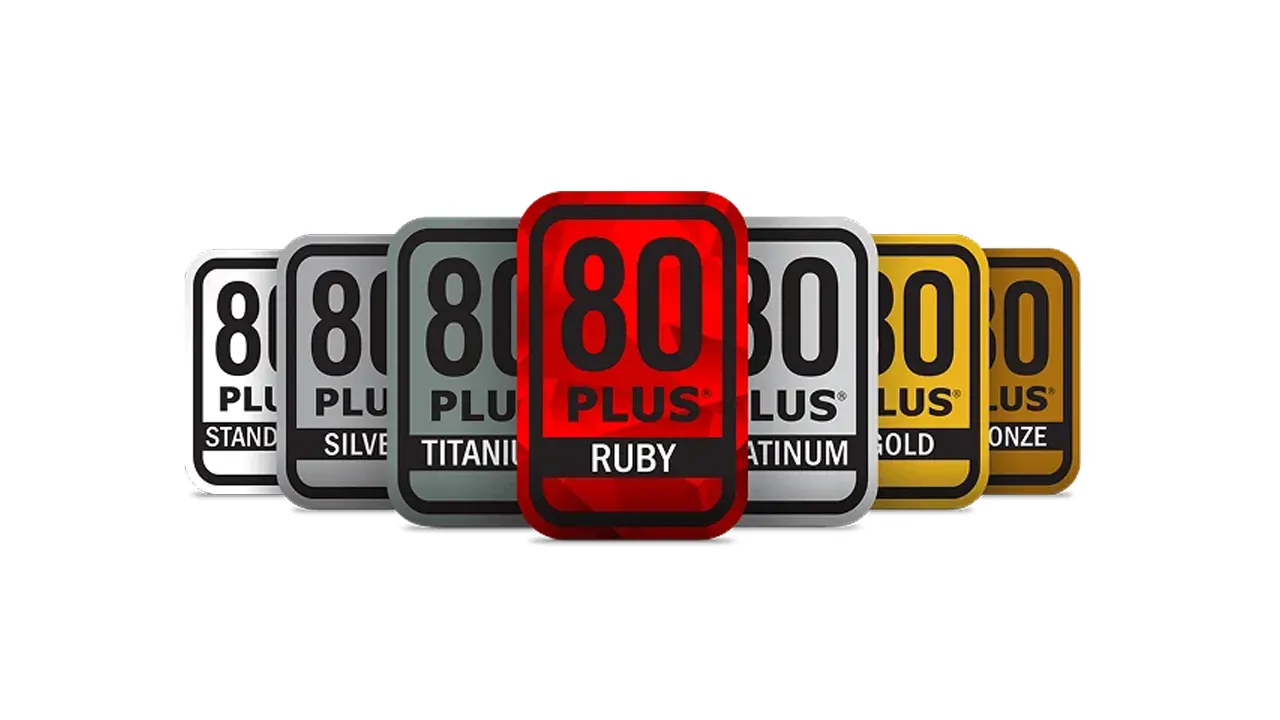
After contributing to the development of the 80 PLUS initiative in its early stages, Seasonic became the first company to bring an 80 PLUS-certified PC power supply to market in 2005. It later became one of the early companies to reach 80 PLUS Gold in 2008. Ruby now represents another step in that progression.
But the importance of Ruby does not lie in the certification name alone.
In a high-output PSU, reducing the amount of power lost during conversion also reduces the heat generated by that process. As output power and operating duration increase, this becomes increasingly relevant to thermal design and overall operating efficiency.
Once again, efficiency returns to its proper place: a fundamental part of PSU engineering rather than simply a label on the box.
From the PC to the Age of AI
The current phase of power-system development differs from previous generations because of the dramatic increase in power consumption across high-performance computing systems.
Modern graphics cards are capable of handling massive AI and parallel-computing workloads. Workstations increasingly rely on high-power GPUs, while local AI development systems demand greater power capacity and stability than conventional PCs.
This helps explain Seasonic’s move toward higher-capacity solutions and products aimed at workstations, professional systems, and AI workloads.
The PRIME ENTERPRISE RX-1600 is a clear example of this direction, having been designed to serve desktop computers, workstations, and high-power AI systems.
Here, reliability becomes more than just a specification.
In a gaming PC, a PSU failure can result in a system shutdown or reboot.
In a workstation processing data or running AI workloads for extended periods, power stability becomes part of the stability of the entire workflow.
Seasonic’s move toward products designed for high-performance computing and AI workloads is therefore not a fundamental departure from its traditional identity. It is a natural extension of the company’s experience in designing high-capacity, high-reliability power supplies.
Executive Summary
Seasonic’s position in the PSU market has not been built on wattage ratings or certifications alone. It is the result of decades of accumulated expertise in power conversion, R&D, platform development, component selection, thermal management, testing, and manufacturing.
Since entering the switching power-supply market in 1980, the company has evolved alongside the changing requirements of computing, from improving power factor and efficiency to addressing the high and rapidly changing loads generated by modern CPUs and GPUs.
This approach is particularly visible in the PRIME family, which represents the upper end of Seasonic’s engineering strategy through technologies such as Micro Tolerance Load Regulation, Cable-Free Connection, high-quality components, Hybrid Fan Control, and support for modern standards such as ATX 3.1.
PRIME, however, is not an isolated example. It is the result of decades of accumulated experience that also includes OEM/ODM activities and the development of platforms for a wide range of applications.
At the same time, Seasonic’s move toward higher efficiency levels, culminating in 80 PLUS Ruby with the PRIME ENTERPRISE RX-1600 in 2026, represents a continuation of this engineering direction rather than an isolated achievement.
As computing power continues to increase and AI workloads and high-performance workstations become more widespread, PSU efficiency, thermal management, and stability under changing loads are becoming increasingly important aspects of modern system design.
This is why Seasonic’s premium positioning can be understood from an engineering perspective before it is viewed as a marketing position.
The value of its products is not simply the amount of power a PSU can deliver, but how that power is delivered, how consistently it is maintained, how efficiently it is converted, how heat and acoustics are managed, what level of protection is provided, and how reliably the platform can operate under prolonged and demanding workloads.
That is the key to understanding Seasonic.
The finished product may look simple from the outside, but the real difference between an ordinary power supply and an advanced platform is created inside the enclosure, through engineering decisions that ultimately reveal themselves through stability, efficiency, and long-term reliability.
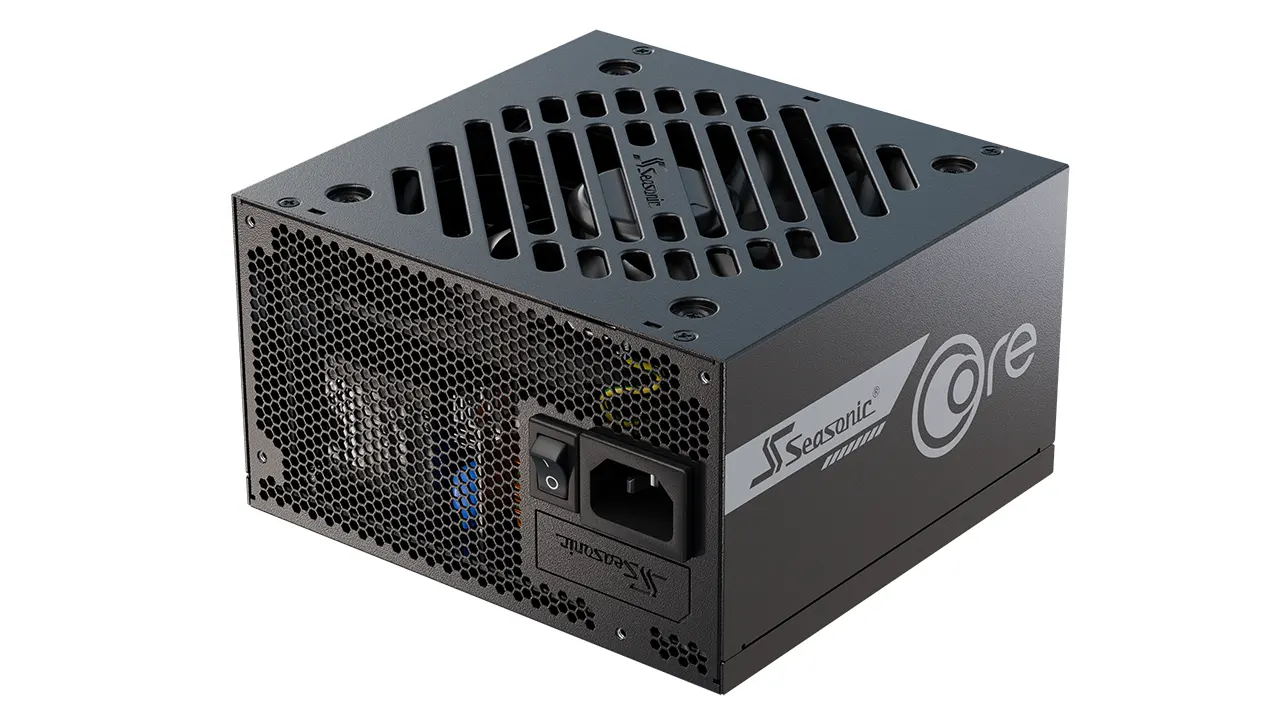
Seasonic: When Power Engineering Becomes the Product
It is easy to describe Seasonic simply as “a company that makes high-quality power supplies.”
But that description alone does not explain its position.
The more important story is the accumulation of engineering experience that began with the company’s founding in 1975, followed by its entry into switching power supplies in 1980 and its continued development across power-conversion technologies, efficiency, power-factor correction, cooling, voltage regulation, protection, and manufacturing.
Then came milestones such as 80 PLUS, PRIME, increasingly efficient architectures, Hybrid Fan Control, OptiSink and OptiGuard, the transition to modern standards such as ATX 3.1, and ultimately the PRIME ENTERPRISE RX-1600 and its 80 PLUS Ruby certification in 2026.
This reveals the fundamental idea behind the brand.
A good power supply is not necessarily the product that attracts attention while the system is running.
It is the product that performs its job so consistently that you rarely have to think about it.
It operates behind the CPU, GPU, memory, storage devices, motherboard, and every other component inside the system.
In the premium segment, the value of a PSU is therefore not determined by its rated wattage alone. It is determined by the quality of the power it delivers, how consistently it maintains that output, how efficiently it converts energy, how well it handles changing loads, how effectively it manages heat and acoustics, the quality of its components, the level of protection it provides, and the operational lifespan it is designed to achieve.
That is what makes Seasonic a particularly relevant case study within the PSU industry.
The finished product may simply be a black box carrying a number such as 1000W, 1300W, or 1600W. Behind that number, however, lies an entire system of engineering, design, testing, and manufacturing.
And ultimately, that system is what allows specialized PSU manufacturers to establish their position in the market.
Seasonic did not build its identity around wattage alone.
It built its identity around power engineering itself.